28 June 2026

Notes from the place-based state 

I think consultancy is closer to haulage than most people imagine. 


We move things around: ideas, methods, bits of practice, half-tested arguments, useful questions. Some are picked up in one place and delivered almost intact somewhere else; others get repacked on the way. 


At Question Factory, a lot of our work is moving ideas and experience down the West Coast Mainline, or across the M62, as lessons from Greater Manchester and the Liverpool City Region travel to new places now building their own devolved institutions. 


But the return journey is getting more interesting. 


Newer strategic authorities are being formed with the benefit of a clearer devolution framework, more powers, and clearer expectations of their role in issues like public health and community safety. They are able to start with questions that older institutions had to discover by accident. 


The trade in ideas between the existing and newly forming MSAs is becoming an increasingly fruitful space to work in and is sparking lots of thoughts about where an ambitious devolution policy should go next.  


Usually, these would stay in client work for a while before we wrote about them more widely. But after spending two excellent days with the Devolution Priority Programme cohort (as kindly convened by the Leadership Centre, Metro Dynamics and Future Governance Forum) – and given our next PM is likely to be the “mayor of some town…” – this feels like a good time to put some of them into the open. 


So, these are some notes from the work we are doing now.  


The central thought is that the next phase of devolution is best understood as the practical work of rebuilding the place-based state. 


Rebuilding the place-based state 


The 20th century state was largely built around vertical systems: departments, funding lines, inspectorates, agencies, professional silos, national programmes and service rules. 


There were good reasons for some of this, including the limits of analogue communications and linear theories of power. And of course, some functions can only sensibly sit at national scale. 


But a family does not experience housing, health, employment, transport and education as separate things; a town centre does not experience business confidence, public safety, planning, transport and utilities as separate things. 


Places receive the state whole, even when the state is organised in pieces. 


An ambitious future devo policy – focused on deepening and not just broadening devolution – needs to engage with the question, “how should the state work when it starts from people and places?” 


The diagram below is deliberately simple – it’s a sketch of a better system. 
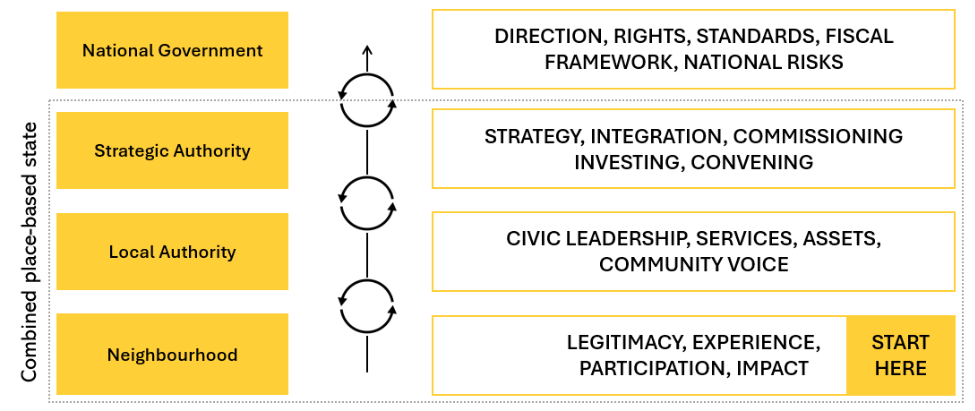
 

It starts with neighbourhoods because that is where the state is experienced most directly; but it recognises the importance of acting in ways that share power and increase participation.  


Local authorities remain the civic and democratic foundation of place and are also returned to their role as the centre of our public service system.  


Strategic authorities are then an expression of the pooled intent of local leaders – a shared space for convening, commissioning and investing across real economic geographies. As part of this, they need to be sophisticated enough to engage with and amplify the complexity of life as it’s experienced at the neighbourhood and local levels. 


National government still has a vital role: to set direction, protect rights, create a sustainable fiscal framework, manage national risks and hold responsibility for standards that should properly be consistent. 


Each layer does the job it is best placed to do, and each layer nests and amplifies the one below it. As we wrote about in this blog, one of devolution’s great strengths is the way it shortens the distance between decision makers and the places where the assumptions those decision rely on, are tested. 


A well-designed place-based state has a better chance of hearing what is happening, interpreting it in context, and changing course quickly enough to make a difference. 


Anyone interested in how and why we should deepen devolution needs to consider how the operating model of the state changes when we take place seriously. There are lots of potential answers that might occur as a result. We’ve picked up three important frontiers that will benefit from consistent testing and exploration. 


Frontier questions 


From the work we are doing now we see three frontiers that any bolder, deeper form of devolution should grapple with. 


The first is to use fiscal devolution as the catalyst to redesign the central state 


Alongside the focus on possible fiscal measures (retained business rates, assigned income tax, the Overnight Visitor Levy etc.) we need to start talking more about what happens to Whitehall when more funding is raised, assigned or retained locally, and spent through locally accountable institutions. 


So much of the relationship between national government and Strategic Authorities is shaped by grant. Grant brings programmes; programmes bring rules; rules bring assurance; assurance brings teams of people whose job is to oversee, approve, monitor and report. 


You can see this wiring of the centralised state written into the operating structure of many MSAs. Skills teams write skills plans to invest skills money on behalf of the skills department. 


When we try and step away from our centralised vertical accountability systems to flex and re-prioritise spend to meaningfully fit places, we have to introduce new complicated bureaucratic junction boxesAs an example, the pic below summarises how this works for the cross departmental Integrated Settlement

(😊). 


If money spent locally always needs to be accounted for nationally, then administrative capacity in Whitehall becomes the rate limiting factor for devolution.  


But if we replace grant with locally accountable revenue the case for detailed departmental control weakens. At this point we need to look seriously at a deliberate programme of capacity transfer. Not a few secondments, but the permanent transfer of the resources needed to fund people, skills and analytical capability from the centre in MSAs, to strengthen the place-based state. That should be done fairly and carefully, but at scale. 


A state that devolves revenue while retaining the same machinery of control will double-run itself into frustration. A state that devolves revenue and transfers capability can start to change how government works. 


The second frontier is how we design a new settlement for devolved public service reform. 


There is now a familiar language around prevention, integration and whole-place working. Most people who work in this field say the right things about the ‘left shift’ to prevention. 


But having studied these issues in detail for the GMCA, two unfortunate truths are hard to avoid: 


  • structural disincentives to integration are still dominant, so successful public service reform relies too much on heroic leadership effort and deep, trusting relationships rather than embedded system design, and 


  • prevention needs new innovations in public finance: the ability to invest over time, across organisational boundaries, and with new mechanisms to capture and reinvest the benefits in, with and for places. 


The best way to achieve this re-wiring is to empower MSAs as the strategic commissioner of services at the whole-place level: sitting between national systems, local authorities and neighbourhood practice, and holding a single view of how public service spending responds to the strengths and needs of places. 


That role needs to become much more than coordination. A new settlement would give MSAs the ability to bring the main demand-shaping budgets into one framework, so prevention, early help, employment support, housing, health, justice and family support can be planned through a unified strategic cycle that drives the incentives and priorities of a purposefully designed and place-responsive delivery model. 


This connects directly to the previous point about fiscal devolution and accountability for public money. 


If public money flows differently into places, accountability has to move with it. Whitehall Accounting Officers cannot remain answerable for choices that have properly moved into place. 


A new settlement would need to put political accountability with the mayor for priorities, trade-offs, recommissioning, reinvestment and the public case for change. It should also allow the Chief Executive of the strategic authority to act as Accounting Officer to Parliament for the devolved funding envelope, so stewardship sits where implementation happens. This accountability will need to sit within national frameworks during the transition period to a fully devolved state.   


The transition period would also need a sanctioned route to depart from national rules where the case is strong. Many barriers to reform sit in guidance, eligibility rules, commissioning expectations, performance frameworks and inspection regimes. Places that go first will need a controlled way to agree time-limited local exceptions, evaluate them properly, and have regulators support the approach. Over time a less rigid inspection system will be needed, balancing national standards with legitimate local variation. 


MSAs also need their hands on the operating conditions for reform: public service capital for estates, digital capability and service redesign; better data sharing across institutional systems and with frontline professionals; and regulation that can assess place-based reform in the round, rather than pulling each service back into its own vertical frame. 


There are risks in here, and these should carried by mayors. The trade-offs are too difficult for Secretaries of State: accountable for one only one part of the system, they carry all the downside even where the benefit appears somewhere else. 


A mayor is accountable for the whole place. That gives them a stronger basis to make difficult trade-offs, reprofile spending across parts of the public service system, invest in a scheme that carries risk, and then carry the political benefits when it works. 


The third frontier is the practice of strategic spatial planning. 


Devolved strategic planning is the untapped superpower of MSA. Not the exercise of technocratic plan-making, but as an exercise in active system leadership that forces political, economic and spatial choices into the same room for long enough that places can agree where growth should be prioritised, what infrastructure it needs, and how investment should be sequenced. 


We can see four aspects to this emerging discipline.   


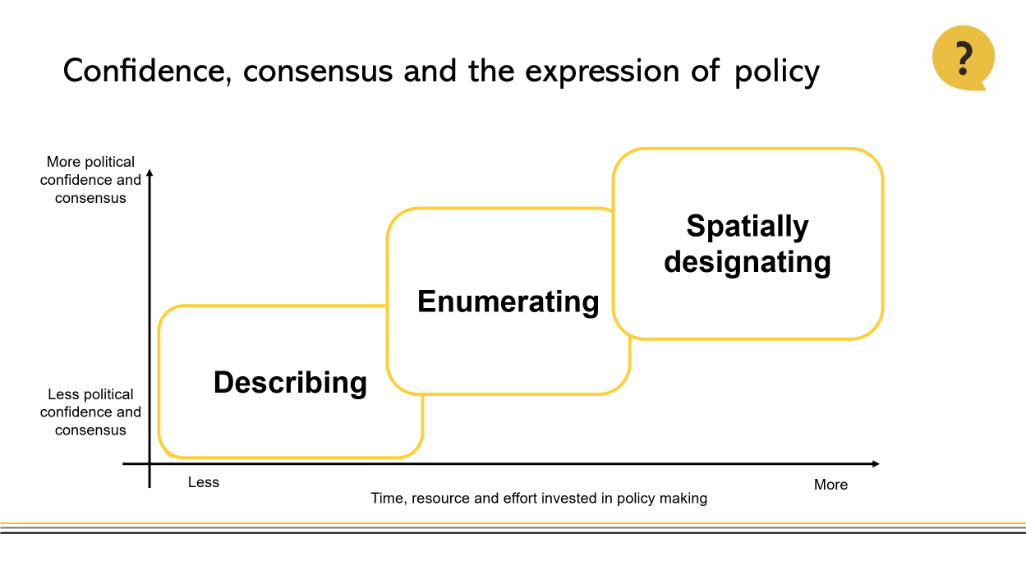
The first part of this is the SDS and the practice of spatial policy making. The SDS is often described as the spatial expression of place strategy – we think it needs to be much more active than that. The SDS process is the route to forging new spatially designated priorities. This is a much more policy-on approach than those steeped in Local Plan making are likely to be comfortable with (and it needs future guidance to provide for a much more strategic basis for Inspection). 


The art of policy making is to build and then document consensus. This takes time, and the less time / consensus there is, the more policy makers rely on the fudgey and the fungible: words expressed in the passive voice, high-level and abstracted statements and goals.  


ith more time, proper evidence can be developed, and this is a place that MSAs are already operating in very effectively: carefully enumerated evidence helps narrow the field of disagreement and firm up more consensus.  


The harder form of policy-making – the pinnacle of the discipline and the USP of MSAs in the wider system of government – is to move beyond this and increasingly express policy as spatially designated priorities. This is how we make trade-offs in the place-based state.  


Obviously, this is politically difficult. But it is the places that can consume this politics and make long-term commitments to spatial priorities that will prosper, and they deserve to prosper.  


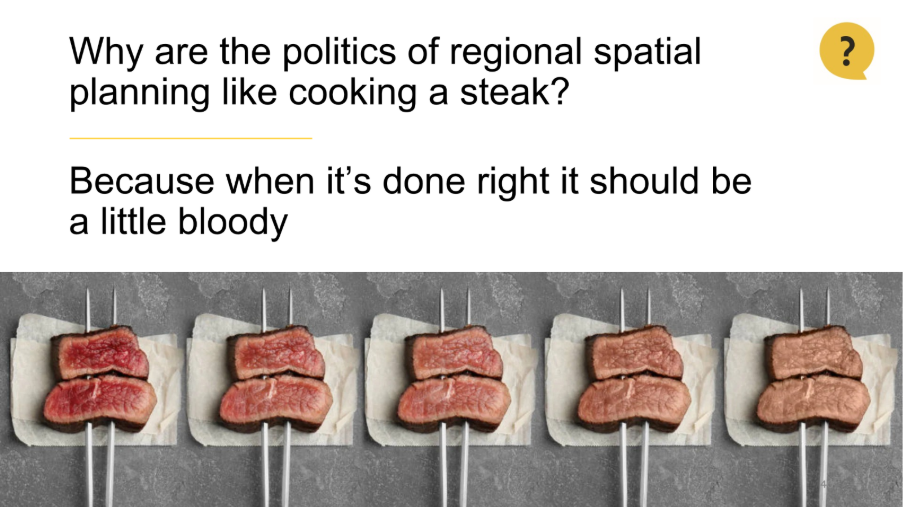
This is serious stuff. It *should* be bloody… 

The second part is the wider delivery system around the SDS. A serious devolution agenda should use the guidance that follows the English Devolution Act to give real force to mayoral convening powers, and to the requirement that local partners have regard to shared local priorities. 

For those interested in Manchsterism, this is a practical, near-term route to more public control of utilities, arms-length bodies and others.   

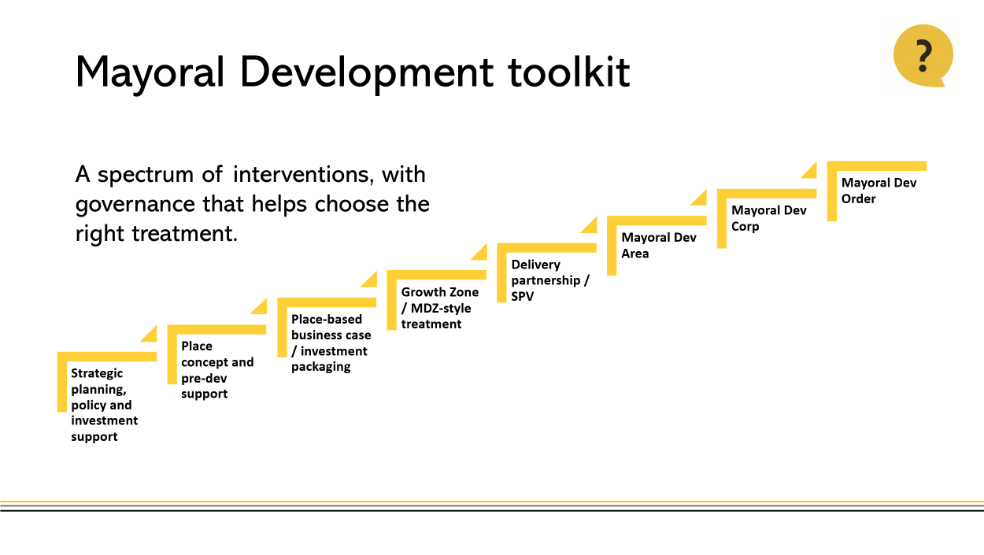
The third aspect is mayoral development. In recent work we have defined this as sustained, place-based partnership between MSAs and constituent councils, focused on increasing land values and unlocking private investment over time. 


That requires building up new professional capability and opening up new governance spaces in mayoral systems, both of which are needed to agree which priority places justify sustained mayoral and local authority support, and how the wider delivery system can be reoriented behind them.  


Sometimes that will mean early planning and investment support. Sometimes it will mean a non-statutory Growth Zone, a delivery partnership, or sometimes a statutory intervention. The point is to professionalise the toolkit and focus it where it can make the greatest long-term difference. Currently there are too many Mayoral hammers looking for MDC nails. 


The final part of this shift are the people themselves – who we talk about when we talk about strategic planners.  


Spatial policy making is a whole-MSA responsibility. Understanding, designing and with places should be the role of people working across policy, politics, evidence, infrastructure, viability, commercial investment, public engagement and delivery. 


Spatial policy making cannot be the preserve of traditional planning policy teams only (however good they are). It is a core practice of the place-based state. 


Building the institutions of the place-based state 


All of this puts a lot of weight on institutions that are still young and still changing. 


This is where our return journey back up to the North West gets interesting. Newer ‘Framework Generation’ MSAs will obviously learn a lot from existing institutions, but they are also starting from a different position: designing for broader responsibilities across growth, public services and strategic planning from the outset.  


Increasingly, we are carrying ideas back from the DPP6 to established MCAs that are wrestling with how to retrofit new competencies into existing structures, cultures and politics. 


When to comes organisational (re)design for MSAs, we’ve written previously that the thing to get right is not a perfect first structure, but the ability to keep evolving the institution as conditions change 


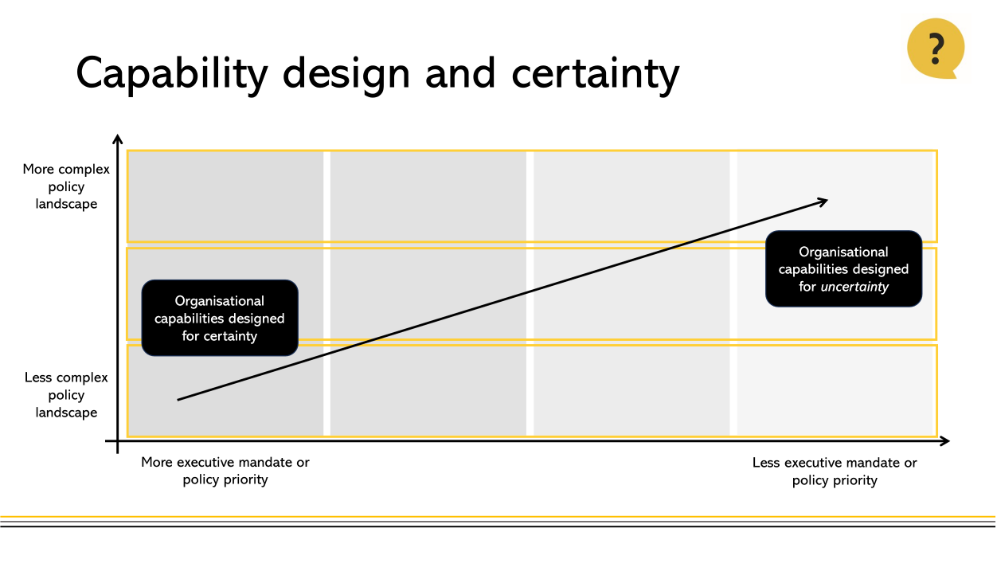
But with a clearer terms of reference from the start, newer authorities have a chance to design HR, governance and assurance, and technology functions that work across the full suite of competencies – from tighter arrangements for high value commission and infrastructure delivery that require greater certainty, to looser arrangements for public service innovation and movement building in uncertain spaces (as set out in the graphic below).  


We think there are two areas here that warrant greater focus. And because this is emergent work creating new knowledge, that focus will have to come from within MSA and their near neighbours themselves. The pace of improvement will be in relation the space and support for this work.  


The first task is to codify the craft. 


At the moment, most of the clothing and language of MSAs is borrowed from nearby traditions: Whitehall policy, local government, economic development, infrastructure planning, business engagement, public service reform and civic leadership. Each brings something useful, but none quite describes the work. 


The distinctive craft of an MSA sits in the combination: convening, building evidence, negotiating priorities, and giving practical form to long-term strategy – but always across a system of systems and without full control. 


That is hard professional work, and we should treat it as such. When new public functions emerge, good systems create language around them. They describe the capabilities, create learning routes, set expectations and build architecture that others can copy, test and improve. Strategic authorities need to create more of that architecture for themselves now. 


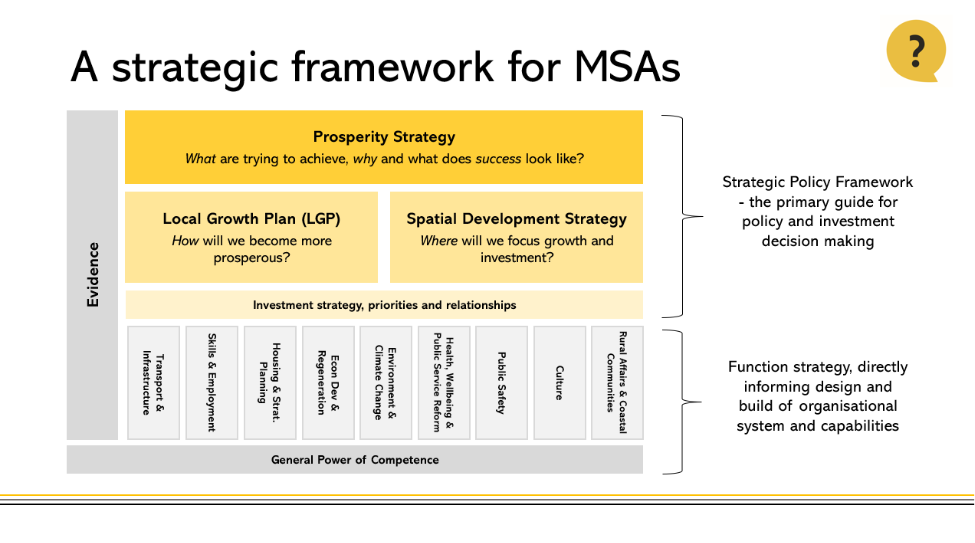
The second task is to build organisations that can prioritise. This starts with a clear strategic framework. 


Many existing MCAs developed their policy architecture incrementally: a funding opportunity arrives or a mayoral priority becomes urgent, and a new plan is devised to provide strategic cover and direction. Over time, climate strategies, skills plans, housing or transport strategies end up sitting next to each other, often as distinct and largely self-contained documents. 


New MSAs have an opportunity to do this differently from the start. They can establish a strategic framework that shows how the main plans relate to each other, what sits above what, and how choices should flow from a shared view of place.  


We’ve worked with three MSAs now to put in place a version of the framework outlined below, both retrofitting it into the policy landscape of existing MSAs, and using it to organise the work of new MSAs.  


Crucially, for MSAs born out of the Devolution Framework, we advise that they need a strong ‘top layer’ strategy to provide the process of distilling and asserting new regional priorities that would previous have happened through the round of deal making with Whitehall.  


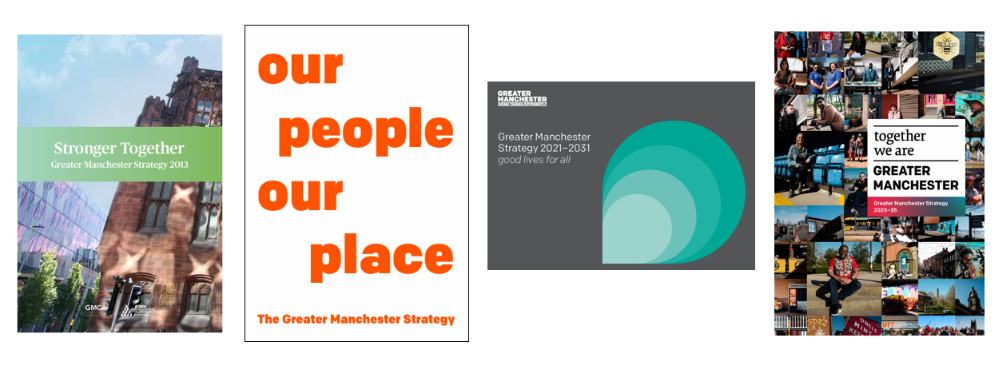
Even in places that have been through the deal making process, we think a locally owned, non-statutory plan is essential to assert the place story, build a shared language, describe the distinctive role of the strategic authority, and define the measures of success that other plans should follow. A local Prosperity Strategy (the name isn’t important) also provides a more flexible tools for updating and evolving as the story of devolution evolves, as we see in the lineage of the Greater Manchester Strategy, below.  


Once an MSA has asserted its local vision as the driving force for prioritisation, the two big statutory plans can kick in – the Local Growth Plan, and the Spatial Development Strategy. Both are too extensive and significant to go into in this blog, but we’ll come back to them. Suffice to say, they need to define the how and where of sustainable growth and future prosperity. (And, unless the political leadership in place is spectacularly capable and far-sighted, it’s worth acknowledging that doing an LGP or an SDS well really does benefit from having an elected Mayor in the mix to provide the grit and governance to drive genuine prioritisation and avoid a cut-and-shut of existing plans.)  


Fleshing out this strategic framework takes time and no one wants to wait for action from a new Authority, so new MSAs should be transparent that, in their early stages, they will take a test and learn approach to the what and the how of strategic prioritisation. This requires a delicate balance: building strategy in iterations so it takes on weight quickly; investing with both tactical and strategic intent (focused on visible early successes but without forming long-term bad habits); and holding our strategic assumptions loosely while new evidence and practice emerges (we talk, in Sussex and Brighton for example, about “working assumptions” not nailed on principles or objectives).  


Once we have a strategic policy framework it needs to be activated through an investment strategy and detailed investment commissioning guidance. 


This is so often the missing middle between policy and evidence colleagues on one side, and commercial investment colleagues on the other. Policy sets out what the authority is trying to achieve; evidence shows where the need, opportunity and constraints sit; and investment strategy can define approaches to public, private and institutional capital; and there will usually be many, many pipelines… 


Investment commissioning guidance fuses these things together to tell the wider investment eco-system, including the MSA, what kinds of opportunities the authority is looking for, where it wants them, what evidence it will use to assess them, and how proposals will need to connect to the agreed strategic framework.  


Without getting better at this, MSAs fall back on the “bring out your dead” approach – unstructured calls, local wish lists, accumulated projects, and the slow and thin spreading of limited investment funds. 


This is a new frontier for combined authorities. We need to get better at using spatial prioritisation, data and more strategic open calls to shape an integrated, place-based pipeline. It’s an area that feels underdeveloped, but if we can tighten up and improve our practice it could have a catalytic impact on the use of MSAs’ limited public funds. It also feels like a sine qua non for places that want to present themselves credibly in discussions with private capital. 


Rebuilding, in practice 


These notes cover just some of the work we’re doing and the discussion we’re supporting.  


At Question Factory, our mission is to help rebuild the place-based state. We do this by creating consensus that sticks, capabilities that last, and momentum that moves people. 


That’s why we see these frontiers as important. Fiscal reform, public service reform, strategic planning, investment prioritisation and institutional design are all part of the same job of work: to re-build a state that starts more seriously from people and places, and has the machinery to act on what it learns. 


These are just some of the thoughts and questions we’re hauling around the country at the moment. Some are already useful. Some still need testing. Most are becoming clearer because they are being worked on in real institutions, with real political choices and real delivery pressure around them. 


That is the work we want to do, and with a new Prime Minister it could all become a lot more urgent. 


So, if you’re an independent practitioner working in this space, or thinking about moving into it, we’d love to hear from you – especially where you can bring combined authority experience or technical skills in planning, data, GIS, investment, infrastructure, HR or public service reform. 


If you’re working through these questions in a council or strategic authority, or you’re in industry wondering what devolution might mean for you, we’re always happy to talk about building strategies, operating models, governance and investment approaches that can hold up to the 21st century. 


And if any of this speaks to questions you’re working through, let’s compare notes.  


We’re always up for testing this new frontier together: not just winning devolution, but making it work in practice.