23rd July 2026

Redeploying our efforts.

Why a rapid and ambitious devolution policy means making better use of what we have.


At Question Factory, we describe our work as helping to rebuild the place-based state. 


That sounds grander than most of the work feels day to day. In practice, it often means helping new and established strategic authorities work out how to do very practical things: build a strategy, design an organisation, get a pipeline into shape, convene partners, make decisions and create enough shared language for people to move in broadly the same direction. 

That last part is often the most important. Lots of skills and capabilities are needed for this work, but our experience suggests that expertise in collaboration is often more valuable than pure technical brilliance in any single area. Combined Authorities need good economists, planners, finance leads, investment specialists, analysts and delivery people. But they also need these people to have the relational skills needed to work across institutions, professions, politics and places; people who can forge agreement and turn it into practical action. 


This is the organisational version of the shift in political culture that Andy Burnham has talked about: place first, collaborative and problem-solving; it makes successful devolution a question of method as well as mandate.  


With the case for deeper devolution now well made and politically driven, more responsibility will sit in places, and more capability will need to sit with it.  


What, and more practically who, that capability is, becomes a central question – for No. 10 North, for the devo-movement, and for (almost) every department and agency of government.  


We wrote recently about the power of enabling constraints. With that in mind, here are some thoughts about working with what we do have, by redeploying efforts from central government and putting them at the service of places.   


Working with what we have 

It’s our experience that the best MSAs have (by fluke or through conscious curation) a mix of central and local government, major infrastructure (often transport) planning skills, strong comms and engagement, an understanding of frontline practice, and a good dose of commercial nous. It takes a mixture.


So this is not an argument that the answer to devolution is simply more civil servants.  


Central government does not have all the skills and capabilities needed for the next phase of devolution, and if it did it wouldn’t be sensible to decant them all into MSAs.  


But it does have a lot of people, and some hold expertise that places will need more of as they take on more responsibilities especially as they manage bigger capital programmes.  


So this is an argument for working with what we have in order to move more quickly (pace rather than perfection).  


We’re working on a capability blueprint for a full-stack MSA. It isn’t yet finished yet, but we can see two obviously key capabilities here –  


One is stewardship of public money: governance, accounting, assurance, risk, audit, scrutiny and transparent decision-making. Devolution can fail through weak control of public money. 


But delivery capability now matters just as much. If poor stewardship makes space for sins of commission, then lack of delivery capability generates sins of omission (or maybe, of no mission…).  


A place can be safe and legal, and yet too weak to prioritise, too timid to grasp opportunities or simply too slow to do the right thing at the right time. It can have the right assurance framework and still lack the people who know how to move a site, test viability, structure an investment, negotiate with an agency, or get a business case through the system. 


Whitehall does have people that can help with this. The practical question is whether enough of that effort can be redeployed towards the new priorities quickly. This is not the time for a perfect institutional blueprint – it’s time to put shoulders to the wheel. 


That means accepting that some people will have to learn on the job. That should not be embarrassing. Everyone in devo-land has been doing exactly that for the last 10 to 15 years. Every strategic authority is an institutional innovation. Much of their capability has been built while carrying real responsibilities, under real scrutiny, with incomplete maps – it hasn’t been perfect but is has shown enough hope and promise to shift the centre of politics. 


The machinery is now moving 

The new government has – sensibly – already started working with what it has, publishing a Written Ministerial Statement that confirms that No. 10 North will sit inside the new Office of the Prime Minister and Cabinet, and will build on local growth and devolution teams through targeted transfers of strategic functions from MHCLG and HMT. This excellent Re:State report anticipated exactly this 


So the redeployment has begun. The question now is how to do we think about and make effective use of this shift. 


How to think about the capability shift to place  

As we start moving capability towards the places there are a few things worth keeping in view: 


  • Routes to capability vary by place. Capability does not all need to sit in one institution, and different places will be able to access different labour markets. Some MSAs will be able to draw on deep pools of public, private, university and agency expertise. Others will find it harder to recruit the technical and professional roles needed. The question is “where does this capability need to sit for the local system to work?”, not “how big should the MSA team be?”
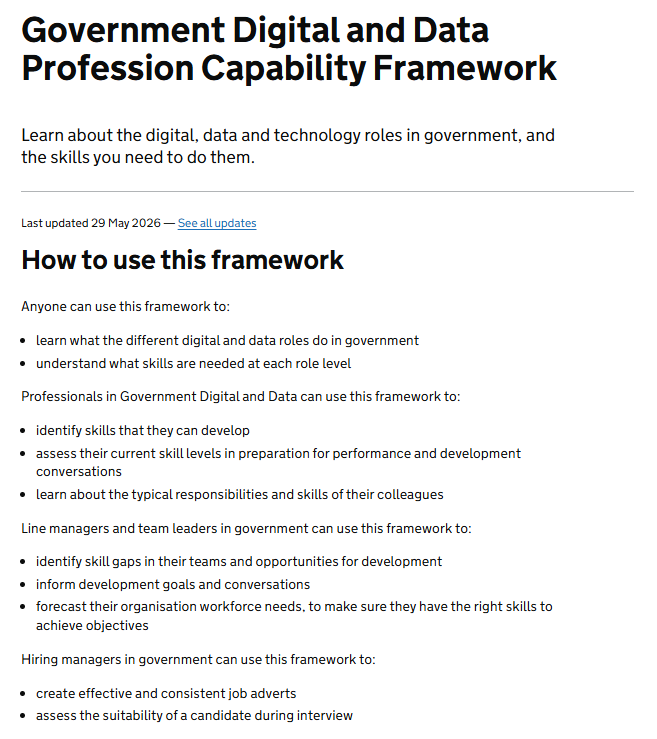
  • We need a better account of the roles required. The Government Digital and Data Profession Capability Framework is a useful precedent: it creates a shared language for roles and skills across government. Devolution needs something similar. The point of codifying these roles is to make the work more visible and transferable. Devolution is creating new professional practice in real time, but much of it is still held in the heads and habits of people doing the work. A clearer account of the roles we mean when we talk about more capability would help places recruit, train, second, procure and share the right expertise with greater accuracy.  
  • Applied capability needs capacity + consensus + delivery. Extra people only help when places know what they want to do, and when they have the licence from the wider system to do it. A new strategy may be needed to build agreement (as with the consensus on strategic housing system shifts we developed for Liverpool City Region in the graphic below); a pipeline may be needed to identify real world opportunities and constraints; a new service may need to be designed to define the skills, roles and recruitment/redeployment routes required.
  • This agenda is deeply counter-cultural for the civil service. It asks departments to release good people, accept more local direction over national capability, and treat MSA / LA work as holding equivalent status as part of a successful career path. It has real implications for the livelihoods of people involved. The current system still gives disproportionate value to proximity to London, departments, ministers and central commissions. A serious devolution capability programme would need to make work in places visible, prestigious and career-enhancing, and would need to stick to that promise over time.  
  • We need to move quickly and restructure over time. The immediate task is to get scarce capability to places. The longer-term task is to build a career ecosystem in which people can move between MSAs, councils, central government and public services.  
  • The state should be clear about the direction of travel. Early and consistent signals are really important because we’re talking about an inversion of the current hierarchy: national capacity and capability being made available at local direction. People will need to know this is a shift that will be sustained.  


Side by side, facing the work 

Central government already spends a lot of time in places, agreeing LGP shared priorities, holding annual conversations, negotiating funding, setting conditions, assuring processes, and monitoring delivery. 


Some of that is necessary. Public money needs proper stewardship, and places taking on more responsibility will need strong governance and assurance. 


But the current model often has departments and places facing each other across the table. A bold redeployment policy should change that posture. 


National capacity and capability should be made available at local direction, where local priorities are clear and responsibility has been properly devolved. The aim should be teams from the centre and teams in place working side by side; the combined effort of the state put behind the same opportunities. 


That could mean working together on sites that will not move, corralling infrastructure providers to address known constraints, working complicated appraisals together, providing joint support to brittle delivery partnerships, making the case for prevention models that do not exactly fit the current rules, and more. In this model, appraising value for money, ensuring public accountability, and managing risks are joint responsibilities.   


Shared work like this helps places make progress *and* gives the centre a better view of what is happening in local economies, because policy and governance gets better when it’s informed by the work. 


Two practical shifts for No. 10 North and the rest of government 

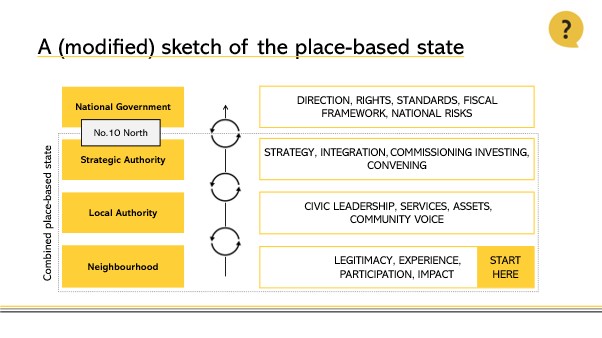
For this to work, No. 10 North will need to organise more than its own teams. It will need to help the rest of government put national capability at the service of places, and make sure the centre is informed by the work happening in places. We’ve modified our sketch of the place-based state to show this bridging role, below.  


We think this points to two early jobs. The first is to turn national capability into something places can use directly. The second is to create live work through which No. 10 North and departments learn from and support big change in places. 


The first is to create a Local Growth Service. This should be a national offer of strategic and technical capability available to MSAs and, through them, to local authorities. It should draw together people from local growth, devolution, Treasury, infrastructure, Homes England and the National Housing Bank, appraisal-heavy departments like DfT, and folk with big service programme management and delivery backgrounds (DWP, Home Office and others) and deploy them in mixed teams against agreed local priorities. 


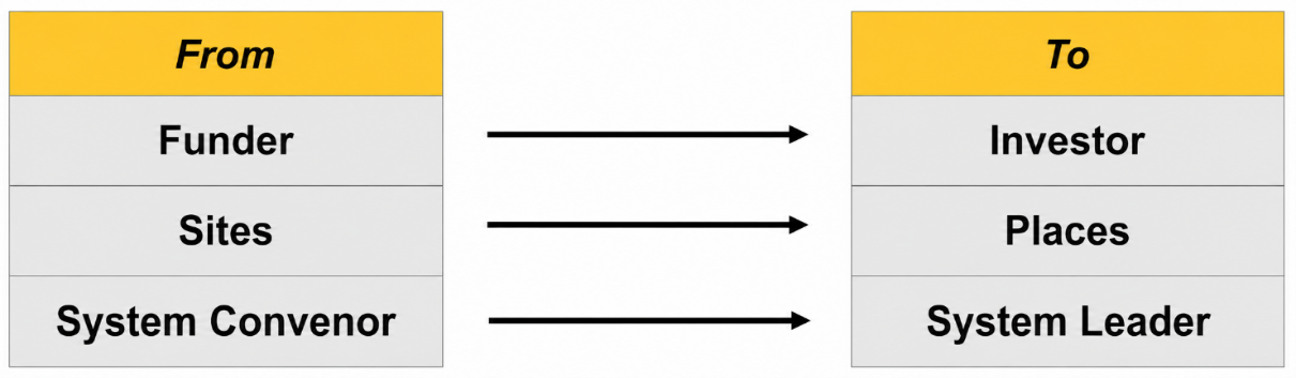
We should think about this as creating a new virtual department or agency: people could remain part of their home departments but be assigned to work on agreed priorities in places. Quotas for the number of staff (basically ‘in-kind’ cuts to current priorities) could be set out at the Autumn Budget Statement. 


MSAs would need to act as intelligent clients, commissioning support against clear priorities and on behalf of constituent local authorities. Government would need to provide strong account management, identify people in advance, and make releasing capability into places part of the expected work of relevant departments and agencies. 


The operating principle would be simple: national capability at local direction. 


A second step would be to deploy an SR27 Growth Locations Programme: a time-limited programme to co-create place-based business cases for identified growth locations in a small number of MSA areas, so that ring-fenced investment decisions can be made at the 2027 Spending Review.  


These should be live pieces of joint work: big ideas, big place regeneration with MSAs, departments, agencies and investors working together through the strategic case, the package of projects required, the sequencing of investment, the public and private contributions, the delivery route, the stewardship arrangements and the capability needed to proceed. 


Put capability into the work 

The changes now underway to create a new Office of the Prime Minister and Cabinet and to establish No. 10 North provide a great opportunity to respond to this moment. 


Devolution is politically agreed. The machinery is starting to move. The task now is to put capability where responsibility is moving. 


That will not happen through new reporting lines alone. It will happen if No. 10 North and the rest of government treat redeploying people to support joint effort as the next practical step: fewer remote programmes, more shared work; fewer parallel conversations, more mixed teams; less commentary from the centre, more shoulders to the wheel. 


Some national activity will need to stop, shrink or change shape to release this capacity. Some people will need to learn the new system by helping to build it. 


That is how devolution has developed in places for the last decade. It can now become part of how the centre changes too. 


No. 10 North can give this a home, a method and a route back into government. Civil servants working with places on growth locations, housing, infrastructure, skills and public service reform would bring more than capacity. They would bring the centre closer to the consequences of its own decisions, and closer to the active innovation already being shown in places. 


That’s how the place-based state gets rebuilt.